Trim when the problem is limited to certain branches and the trunk and roots are sound. Remove when the trunk is split or decayed, the tree is dead or extensive deadwood or significant dieback, or it's leaning in a way it didn't used to. Trimming keeps the tree; removal takes it out entirely. If you're not sure which side of that line your tree falls on, a certified arborist can look at it in person — this guide will get you most of the way there on your own.
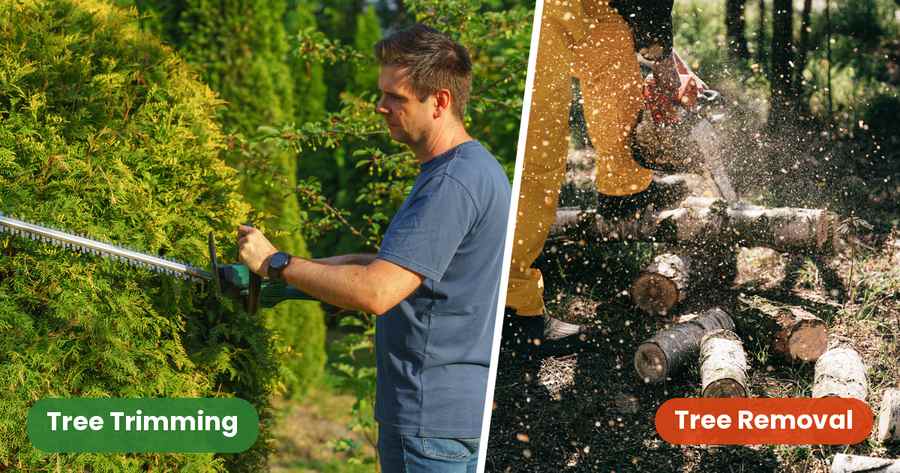
Most people don't wake up wanting to remove a tree. They notice a problem — a leaning trunk, a bare patch in the canopy, branches that keep dropping — and then have to figure out whether that problem calls for a haircut or a full removal. The two aren't interchangeable, and picking the wrong one either wastes money or leaves a hazard standing in your yard. This guide walks through how to tell them apart.
What's in this guide
The Basic Difference
Tree trimming (also called pruning) removes specific branches while leaving the tree standing. It's done to clear dead or damaged wood, improve shape, reduce weight on weak limbs, or keep growth away from a roof or power line. The tree survives and, done correctly, is usually healthier for it.
Tree removal takes the whole tree down, trunk and all, and usually includes grinding or removing the stump afterward. It's permanent. Removal is the right call when the tree itself — not just a few branches — is the problem: it's dead, structurally unsound, or posing a risk that trimming can't fix.
The short version: trimming treats a part of the tree. Removal treats the whole tree as the issue.
When Trimming Is Enough
Trimming is usually the right move when:
- Only a portion of the branches are dead, damaged, or diseased, and the trunk looks sound
- Branches are rubbing against a roof, siding, or power line
- The canopy has gotten lopsided or too dense and needs shaping
- Low limbs are blocking a walkway, driveway, or view
- The tree needs routine maintenance to stay healthy, which most trees benefit from every 1–3 years depending on species and growth rate
If the tree is otherwise healthy and the concern is contained to specific limbs, trimming addresses it directly without losing the tree.
When You Need Removal
Removal is generally the safer and more practical choice when:
- The tree is dead or has extensive deadwood. — dead wood doesn't come back, and a mostly-dead tree is a falling hazard
- The trunk is split, hollow, or visibly decayed — this affects the tree's structural core, which trimming branches can't repair
- The tree has developed a new or worsening lean — especially after a storm, this can signal root failure
- Roots are damaged, cut, or lifting — from construction, flooding, or disease
- It's too close to a structure and already showing instability — trimming can reduce risk temporarily but won't fix an unstable tree long-term
- Fixing the problem would mean cutting away most of the canopy — at that point trimming stresses the tree so much it may not recover anyway
If the issue is with the trunk or root system rather than the branches, that's usually the clearest sign trimming won't be enough.
Trimming vs. Removal, Side by Side
| Tree Trimming | Tree Removal | |
|---|---|---|
| What it does | Cuts back specific branches | Cuts down the entire tree |
| Tree survives? | Yes | No — permanent |
| Typical trigger | Dead/damaged branches, overgrowth, shaping, clearance from structures | Dead or dying tree, trunk/root damage, instability, severe storm damage |
| Frequency | Routine — often every 1–3 years | One-time, per tree |
| Stump involved? | No | Usually yes, unless stump grinding or removal is included |
| Permit more likely? | Less often, unless it's a protected/heritage tree | More often — check your local ordinance |
Permit rules are set locally, not nationally — see our tree removal permit guide for how to check yours.
How Much of the Tree Is Affected?
One of the more useful ways arborists think about this: how much of the live canopy needs to come off to solve the problem. Removing a small share of branches is routine maintenance. Removing a large share puts real stress on the tree and can push it into decline anyway — at which point trimming has only delayed the same outcome.
These percentages are general guidance, not a rule for deciding whether a tree should be removed. Appropriate pruning limits vary by species, tree condition, age, structure, site, and pruning objective. A qualified arborist should assess trees that require extensive pruning or show structural problems.
Already know which one you need?
Get a free, instant estimate for either service based on your tree's size and details.
Trees on a Property Line
If the tree sits on or straddles a boundary line, the decision usually isn't yours to make alone. A tree whose trunk is on the property line is typically considered jointly owned, and one owner generally can't remove it without the other's agreement. You can usually trim branches that overhang your side back to the line, but if that trimming ends up harming the tree, you can be held responsible. If there's any ambiguity about ownership or the tree affects a shared area, it's worth sorting that out with your neighbor — and possibly a professional assessment — before any cutting starts.
What Happens If You Pick Wrong
Trimming a tree that actually needs removal usually just delays the inevitable. If the core problem is a compromised trunk or failing roots, cutting back branches doesn't fix that — the tree is still a falling risk, it just looks tidier in the meantime.
Removing a tree that only needed trimming means losing a tree you didn't have to lose — along with its shade, its value to the property, and the years it would've taken to grow a replacement to the same size. It's also simply more expensive than the trim would have been.
When you're genuinely unsure which one you're dealing with, that uncertainty itself is a reason to get a professional opinion rather than guess.
Quick Decision Checklist
| If you see this… | It usually points to… |
|---|---|
| A few dead or broken branches, rest of tree looks healthy | Trimming |
| Branches too close to the roof, siding, or power lines | Trimming |
| Whole tree is bare, brittle, or shows no new growth | Removal |
| Trunk has a visible crack, split, or soft/hollow spot | Removal |
| Tree is leaning more than it used to, especially after a storm | Removal |
| Roots are exposed, cut, or lifting the ground/pavement | Removal |
| Overgrown but structurally sound, just needs shaping | Trimming |
If your tree checks boxes in both columns, that's a sign to get an in-person opinion rather than decide from a list.
Sources & Further Reading
- ISA – Recognizing Tree Risk
- ISA – Pruning Mature Trees
- ISA – Why Hire an Arborist
- Arbor Day Foundation – When It's Time to Remove Your Tree
- Penn State Extension – Pruning Landscape Trees
- NC State Extension – General Pruning Techniques
- Nolo – Laws on Tree Disputes with Neighbors
Frequently Asked Questions
How do I know if my tree needs trimming or removal?
If the problem is limited to specific branches and the trunk and root system are sound, trimming usually solves it. If the trunk is split, the tree is more than half dead, or it's leaning more than it used to, removal is typically the safer call.
Can trimming fix a dying tree?
Sometimes, if the decline is limited to certain branches and the core of the tree is still healthy. If most of the canopy is dead or the trunk shows decay, trimming alone generally won't reverse that.
Is it cheaper to trim a tree or remove it?
Trimming is usually the smaller job since it targets specific branches, while removal involves taking down the whole tree. Get a quote for your specific tree, since size, access, and condition affect both — you can start with our removal calculator or trimming calculator.
How much of a tree can be trimmed before it needs to come down instead?
Many arborists avoid removing more than roughly a quarter to a third of a tree's live canopy in one go. If more than that needs to come off to deal with damage or decay, removal is often the more realistic option.
What if only half the tree is dead?
It depends on which half and why. If the dead portion is a few branches, trimming can work. If dieback affects a large share of the canopy or points to root or trunk problems, an arborist will often recommend removal instead.
⚠️ Not sure and the tree looks unstable? Keep people and vehicles away from it and get a certified arborist out to assess it — don't wait to decide between trimming and removal on your own if there's an immediate risk of it falling.