A tree comes down, and the first call most people want to make isn't to an arborist — it's to their insurance company. Fair enough. Removal alone can run a few hundred to a few thousand dollars, and the honest answer to whether insurance covers it is: usually, homeowners insurance covers tree removal when a covered peril — wind, lightning, hail, or snow load — causes the tree to damage an insured structure. If the tree falls in your yard without hitting anything, or came down because it was already dead or rotting, removal is generally on you. Your policy's debris-removal sub-limit and deductible still apply either way.
We spend our time helping homeowners figure out what tree work actually costs, which means we hear the insurance question constantly — usually right after someone's already gotten a removal quote and is trying to decide whether it's worth filing a claim at all. This guide walks through what typically determines that, using the same logic insurers apply, plus a few practical angles that get glossed over elsewhere.
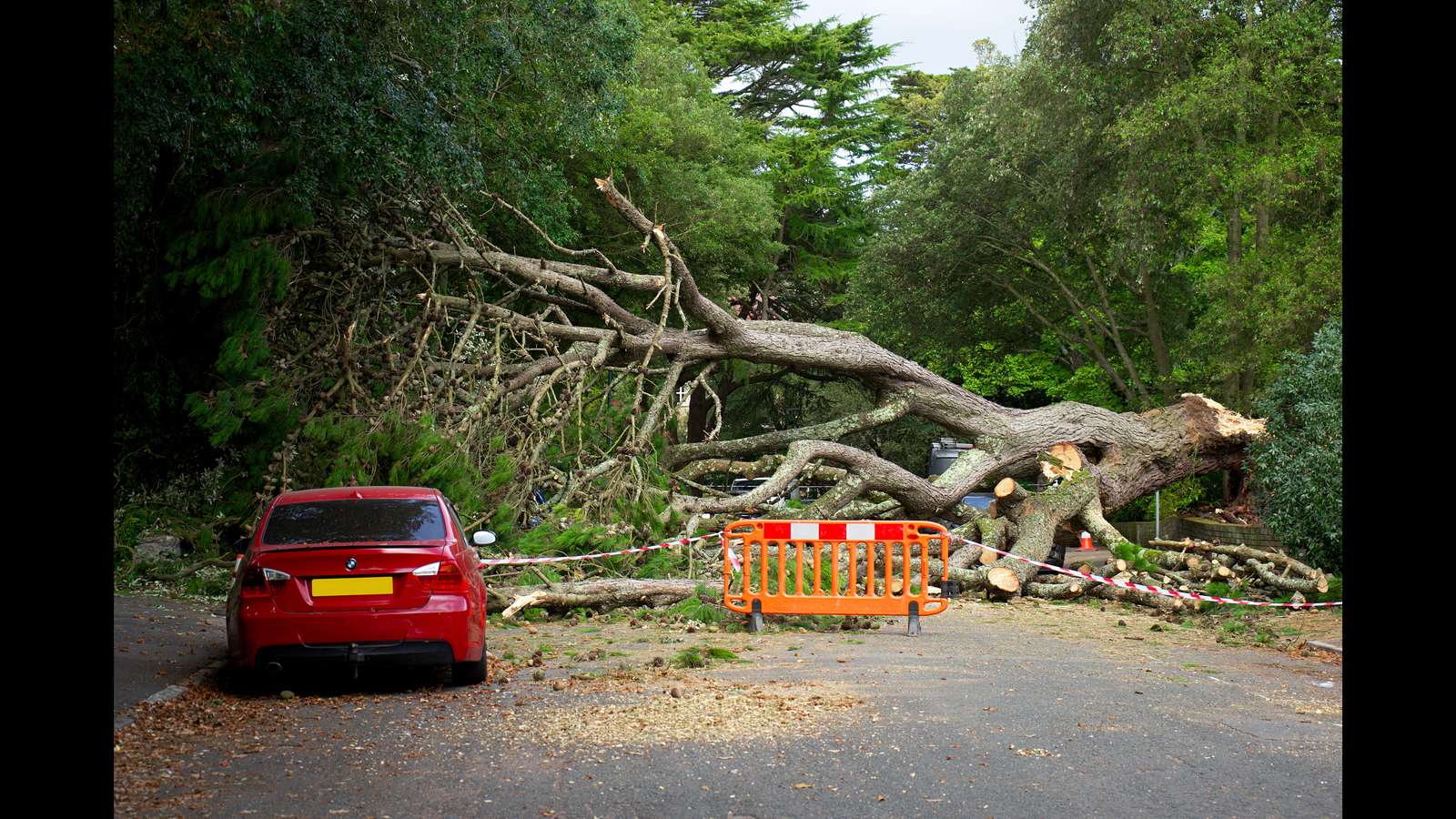
Your policy almost certainly pays for removal if a covered peril — wind, hail, lightning, snow load — knocked the tree into your house, garage, or another insured structure. If the tree just falls in the yard and hits nothing, or if it came down because it was already dead or rotting, you're almost always on your own for cleanup.
What's in this guide
When It's Covered
Every major carrier applies roughly the same test: was the tree brought down by something your policy classifies as a covered peril, and did it land on something insured? If both are true, removal is typically bundled in with the structural repair claim, not treated as a separate expense you have to argue for.
Perils that usually qualify:
- Wind and windstorms
- Hail
- Lightning strikes
- Heavy snow or ice load
- Fire
- Vandalism, or a vehicle crashing into the tree
And "landed on something insured" is broader than just your roof — a garage or other covered structure on your property may qualify too, though exactly which structures count (fences, sheds, detached structures) depends on your specific policy, so it's worth confirming with your agent rather than assuming.
When It's Not Covered
The exclusions trip people up more than the coverage does, mostly because they feel unfair in the moment. A few of the most common:
- The tree was already unhealthy. Rot, disease, or old age causing a tree to fall is treated as a maintenance failure, not an accident — and maintenance is on you.
- Nothing got damaged. A tree that falls cleanly into open yard, without touching your house or any other insured structure, generally isn't covered at all, even if the same storm caused plenty of damage elsewhere.
- You wanted it gone before it fell. Preventative removal — taking down a tree because it looks dangerous — is routine property upkeep in every insurer's eyes, full stop.
- Flood or earthquake, without the right endorsement. Standard policies exclude both perils outright; you'd need a separate flood or earthquake policy for a tree felled by either to be covered.
Covered vs. Not Covered, Side by Side
| Scenario | Typically Covered? |
|---|---|
| Windstorm topples a tree onto your roof | ✅ Often covered |
| Lightning splits a tree, which falls on your fence | ✅ Often covered |
| Storm knocks a tree into open yard, nothing else touched | ❌ Usually not covered |
| A visibly dead or rotting tree falls on its own | ❌ Usually not covered |
| You remove a leaning tree before it falls | ❌ Usually not covered |
| Tree falls and blocks your driveway, no structural damage | ⚠️ Policy-dependent — some carriers make a limited exception |
| Flood undermines roots and the tree falls, no flood policy | ❌ Not covered under standard homeowners policies |
The Neighbor's-Tree Question
This one surprises people the most. If a neighbor's tree falls on your house, you generally file with your own insurer first — not theirs — assuming a covered peril was the cause. Your carrier pays out, then quietly sorts out reimbursement with your neighbor's insurer behind the scenes if negligence turns out to be a factor. You're rarely involved in that part. The reverse is also true: if your tree falls on their property, their insurance is typically the first call, not yours.
What actually happens depends on the cause, not just whose tree it was:
- A storm caused a healthy tree to fall. This is treated as a straightforward cause-of-loss claim — you file with your own insurer regardless of whose property the tree started on.
- The neighbor's negligence contributed. If they'd let a tree rot for years or ignored a hazard, your insurer can still pay you first, then pursue reimbursement from your neighbor or their insurer separately — a process called subrogation.
- The tree was visibly hazardous and the neighbor knew. A documented warning — an email, a certified letter, a photo with a date — strengthens a subrogation case significantly and can shift more of the cost back to them.
Negligence changes the math in the other direction too. If you were warned in writing that a tree on your property was hazardous and did nothing, an insurer can point to that as grounds to deny a claim or seek reimbursement from you directly — which is one more reason a paper trail matters more than most people realize.
How Much Insurers Actually Pay
Even when a claim is approved, "covered" doesn't mean unlimited. Debris removal — which includes hauling away a fallen tree — is usually its own separate sub-limit inside your policy, distinct from the dwelling coverage that pays for structural repairs. Industry pricing guides commonly cite a range somewhere around $500 to $1,000 per occurrence for this sub-limit, though the actual amount and how it's structured (a flat dollar cap vs. a percentage of your dwelling coverage) varies meaningfully by insurer and by policy — treat that range as a ballpark, not a number to plan around. Some carriers also layer a per-tree cap on top: for example, a limit per tree with a separate total cap per storm, meaning several downed trees in the same event could exceed what's covered.
The practical takeaway: don't assume "covered" means "fully covered." It's worth asking your agent directly what your specific debris removal sub-limit is, since it varies more between carriers than most of the broader coverage language does.
A Few Special Cases
A tree lands on your car
This one falls outside homeowners insurance entirely. A tree crushing your car is a comprehensive auto insurance claim, not a home insurance one — different policy, different deductible.
The tree threatens power lines
If a tree is growing into or leaning toward utility lines, it's worth calling your utility company before calling anyone else. Many utilities will trim or remove the portion of a tree threatening their infrastructure at no cost to you, since it's a hazard to their equipment too — a detail that rarely comes up in insurance-focused guides, but can genuinely save homeowners a full removal bill.
A tree blocks a wheelchair ramp or the only driveway access
Some policies provide limited coverage in this specific situation, even without structural damage, when a fallen tree blocks the sole access point for a resident who uses a wheelchair ramp, or the only driveway in or out of the property. This is far from universal — the requirements and whether it applies at all vary substantially by policy, so it's worth asking your agent directly rather than assuming it's covered.
Should You Even File a Claim?
Assuming your situation is covered, filing still isn't automatic — it's worth doing the math first. If your deductible is $1,500 and an arborist quotes the removal at $700, filing a claim gains you nothing; you'd pay the full $700 out of pocket either way, since it falls under your deductible, and you'd also risk a premium increase down the line for having a claim on file.
This is really the crux of why removal pricing matters before the insurance conversation even starts. Knowing a realistic number for your specific tree — not a generic "trees cost $200 to $2,500" range — is what makes that comparison possible in the first place.
Get a real number before you decide
Enter your tree's height, trunk diameter, species, and ZIP code to see what removal actually costs — then compare it against your deductible.
Calculate My Cost →Improving Your Odds of Approval
A few habits meaningfully change how a claim gets treated, mostly by heading off the "was this tree already unhealthy" question before an adjuster has to ask it:
- Keep dated photos of your trees. A few phone photos taken over time, showing a tree looked healthy before a storm, is often enough to counter a rot-and-negligence argument.
- Get periodic arborist check-ins for older or larger trees. A written inspection report is stronger evidence than a photo, and it's the same document that protects you if a neighbor ever claims you ignored a warning.
- Document the storm itself. Local weather reports or news coverage of a wind or hail event help establish that a covered peril, not neglect, caused the damage.
- Report and mitigate quickly. Tarping an exposed roof or fencing off a hazard right away shows you didn't let secondary damage pile up — insurers care about that.
What to Do Immediately After a Tree Falls
What you do in the first hour or two can affect both your safety and how smoothly a claim goes, if you end up filing one:
- Make sure everyone is safe first. Stay away from the tree if it's near power lines — treat any downed line as live until the utility company confirms otherwise.
- Photograph everything before any cleanup. The tree, the damage, and the surrounding area — from multiple angles, before anything is moved or cut.
- Prevent additional damage where it's reasonably safe to do so. A tarp over an exposed roof section is reasonable; climbing on unstable debris is not.
- Contact your insurer if there's covered property damage. Report it promptly — most policies expect timely notice, and delays can complicate a claim.
- Get a written removal estimate from an arborist. You'll need this whether or not you end up filing a claim.
- Don't authorize major permanent repairs before talking to your insurer. Emergency mitigation (tarping, fencing off a hazard) is fine — full repairs before the claim is reviewed can complicate things.
- Keep every receipt. Emergency tarping, temporary fencing, and removal costs are often reimbursable even before a full claim is settled — but only if you can show them.
Frequently Asked Questions
Will my insurance pay to remove a tree that fell in my yard but hit nothing?
Usually not. If a tree comes down and doesn't damage your house, garage, fence, or another insured structure, most standard policies leave the cleanup to you, even though the same storm might have caused the tree to fall.
Who pays if my neighbor's tree falls on my house?
Your own homeowners policy, not your neighbor's, typically pays first, assuming a covered peril caused the fall. Your insurer may later try to recover costs from your neighbor's insurer if negligence is involved, but that happens behind the scenes.
Does insurance cover removing a dead tree before it falls?
No. Preventative removal of a dead, dying, or hazardous tree is considered routine property maintenance, and it's almost never covered, regardless of how much of a threat the tree poses.
Is there a limit on how much insurance will pay for tree removal?
Yes. Most policies cap debris removal at a set dollar amount — commonly cited as somewhere around $500 to $1,000, though this varies by insurer and policy — sometimes expressed instead as a small percentage of your dwelling coverage, with some insurers also applying a per-tree sublimit on top.
Does homeowners insurance cover a tree that falls on my fence?
Often yes, if a covered peril (wind, lightning, etc.) caused the tree to fall — a fence is frequently, though not always, treated as a covered structure. Whether it's included depends on your specific policy, so it's worth confirming with your agent rather than assuming.
Will filing a tree removal claim increase my insurance rates?
It can. Any claim on file, even one caused by a storm rather than negligence, may be a factor insurers weigh at renewal, depending on your state and carrier. This is exactly why it's worth comparing the removal cost against your deductible first — if the cost would fall under your deductible anyway, filing gains you nothing and only adds a claim to your record.
💡 Not sure if filing is worth it? Get a realistic removal estimate for your exact tree first, then weigh it against your deductible. Try the free calculator →
This guide reflects general coverage patterns described across major U.S. homeowners insurance carriers and industry pricing resources as of 2026, cross-checked for consistency rather than pulled from a single source. It is not a substitute for your actual policy language. Coverage details, sub-limits, and exclusions vary by policy, carrier, and state — always confirm specifics with your own insurance agent before making a decision based on this article.
Related Guides
- Do I Need a Permit to Trim a Tree?
- Tree Pruning vs. Trimming: What's the Difference?
- Do I Need a Permit to Remove a Tree?
- Dead Tree Removal Cost: 2026 Price Guide
- Fallen Tree Removal Cost: 2026 Price Guide
- How Much Does It Cost to Remove a Tree in 2026?
- Stump Removal Cost: 2026 Price Guide
- Browse all guides →